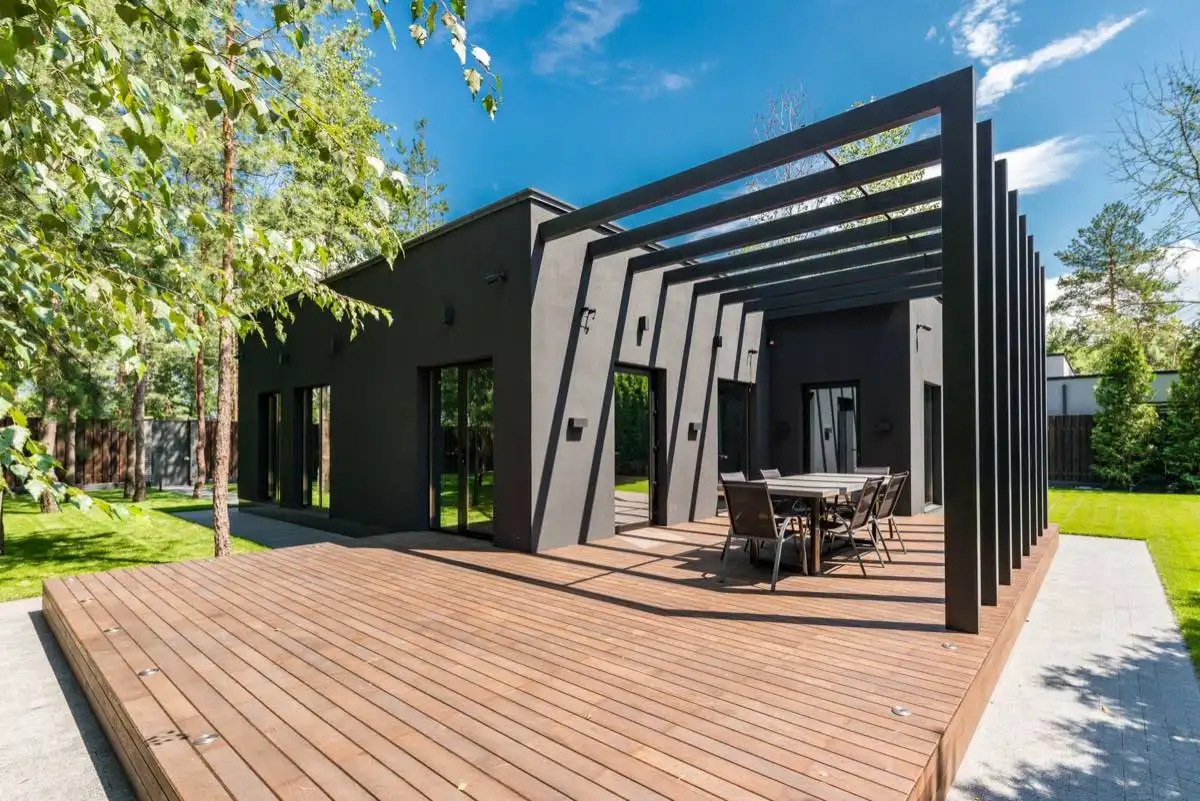
A pergola is an open-rafter shade structure and a patio cover is an actual roof — that is the entire difference, and it decides everything else. Both sit on posts, both bolt to footings, both can be aluminum or wood. One lets the sky through on purpose. The other doesn't.
That distinction sounds obvious right up until you're standing under a beautiful new pergola in a rain shower, watching your dinner get wet through the world's most expensive set of stripes. So let's sort out which one belongs on your slab before anyone pours concrete.
Pergola vs patio cover at a glance
| Pergola (open rafters) | Patio cover (solid roof) | |
|---|---|---|
| Shade | Roughly 40–70%, moves with the sun | 100%, all day |
| Rain | Passes straight through | Keeps you dry |
| Typical installed cost | The baseline in this category | Roughly 1.3x the pergola solid, closer to 2x insulated |
| Light into the house behind it | Barely changes | Noticeably dimmer |
| Ceiling fan, lights, TV | Awkward, needs planning | Easy, there's a ceiling |
| Best for | Look, dappled light, plants, morning use | Dining, kitchens, all-day and all-weather use |
The short version: a pergola sells the look, a patio cover sells the hours. If you want a good-looking structure and shade that shifts across the afternoon, the pergola is honest value. If you want to eat outside in a downpour, only the roof does that.
What a pergola actually is
A pergola is posts, beams, and rafters with air between the rafters. Traditional wood versions use 2x6 or 2x8 rafters at 12 to 24 inch spacing; aluminum versions use extruded blades in similar spacing. Shade lands somewhere in the 40 to 70 percent range depending on blade width and spacing, and it moves all day, which is either charming or annoying depending on whether you're reading or eating.
Wood pergolas are cheaper to buy and more expensive to own. Cedar and pressure-treated pine both want a clean-and-seal cycle roughly every two to three years, and in a humid market they want it more often than that. Powder-coated aluminum costs a bit more on day one and then asks for a hose.
The upgrade path most people don't know about: a louvered pergola with motorized adjustable blades — Struxure, Equinox and similar systems — closes to a watertight roof and opens back to slats. Some models come with rain sensors that close them for you. They also run roughly $80 to $150-plus per square foot, so it's a fantastic product and a genuinely serious number.
What a patio cover actually is
A patio cover is the same skeleton carrying a continuous roof deck, and on residential work that deck is nearly always extruded aluminum pan. For this particular comparison the deck matters less as a product than as a load.
It adds dead weight the beams have to carry. More importantly, it converts a structure the wind blows through into a surface the wind pushes on, and pushes hardest upward. That is why a cover and a pergola of identical footprint do not get identical members, identical anchors, or identical footings — one of them is arguing with uplift and the other is letting it past.
Which pan you end up with, and whether it has a foam core and an R-value stamped on it, changes span, weight, rain noise and how the space feels at three in the afternoon. All of that is worked out in our insulated patio cover cost guide. The only fork this page needs is deck or no deck.
The parts that are identical (and where the real risk lives)
Here's what most comparison articles skip: below the roofline, both are the same job. So this is the page where we set that job out properly.
Footings, and the two numbers people conflate. The code floor is that an exterior footing bear at least 12 inches below undisturbed ground and below the local frost line, whichever is deeper — IRC section R403.1.4, with the frost depth itself coming from your jurisdiction's row of IRC Table R301.2. That part is code. What a crew actually pours for a post is a trade norm sitting on top of it: commonly a pier 12 to 24 inches across and 18 to 36 inches deep, growing as tributary area and soil bearing demand, the way IRC Table R507.3.1 sizes them for deck posts. Frost sets the depth and frost is regional — effectively nothing in south Florida, past five feet in northern Minnesota. A quote that names one depth without asking your county was not looked up.
Post bases. A Simpson-style standoff base lifts the post an inch clear of the concrete so wood end grain, or a powder-coated aluminum foot, isn't parked in a puddle for twenty years. Cheap part. Large consequence.
Ledger and flashing. Attached, either structure hangs off a ledger lagged into the house band joist. A badly flashed ledger is the single most expensive mistake in this trade. It doesn't fail loudly. It wicks behind your siding for four years until somebody finds soft sheathing. Where a roofline or stucco won't take a clean ledger, free-standing on two extra posts beats the rot repair every time.
Wind is the shared question that isn't a rule of thumb at all — it's whatever design speed your department reads out of the ASCE 7 edition it adopted, and the figures in general circulation are a code cycle stale. Current numbers, and why the old one is wrong, are in the patio cover permits guide. Snow markets size the same beams from the opposite direction.
When to skip us entirely
A 10x10 kit pergola set on an existing, sound slab is a real weekend project for two people with a hammer drill and a level. Kits run roughly $1,200 to $3,500, the hardware comes in the box, and if your jurisdiction exempts small free-standing structures you may not even need a permit — though you will still need to respect setbacks. If you want shade and a Saturday, buy the kit. We'll say that before we say anything about hiring us.
Where it stops being a DIY job is the moment the structure touches the house or carries a solid roof deck. Ledger flashing, uplift anchoring, and footings sized to code are not vibes-based work, and a failed inspection costs more than the labor you saved.
The call, with no hedging
If you'll use the patio more than twice a week, get the solid cover. Here's the math: a pergola costs roughly $15 to $30 a square foot and gives you a space that's pleasant maybe four months a year in the shoulder hours. A solid cover costs roughly $20 to $40 and gives you a space that works in midday sun and in rain. That's a difference of a few thousand dollars on a typical 12x20 — about $4,000 to $9,000 for solid aluminum versus $3,600 to $7,200 for lattice — and it buys you most of a year instead of a season.
The exception is real and worth naming: if the patio faces a window you love, a solid roof will noticeably darken the room behind it. That's the one case where a pergola, or a combination cover with a solid section over the table and open rafters near the glass, wins on merit rather than on price. Same logic drives the lattice vs solid patio cover decision within aluminum systems.
Bottom line
Pergola for looks, plants, dappled light, and a lower number. Patio cover for dining, electronics, outdoor kitchens, and days that don't cooperate. Build either one on proper footings with a properly flashed ledger, engineered to your local wind numbers, and it'll outlast the furniture you put under it.
Boca Raton Elite Patio Covers builds both across Boca Raton and south Palm Beach County — aluminum pergolas, insulated solid-roof covers, and full outdoor living builds with the electrical roughed in before the panels go on. We'll measure the slab, look at your roofline, and tell you which one your yard actually needs, including when that answer is the cheaper one. Call (844) 743-2006.
Ready for a free quote in Boca Raton?
Boca Raton Elite Patio Covers — free estimate, clear scope, no pressure. Use the form on this page or jump to the homepage quote.
Related services in Boca Raton
Boca Raton Elite Patio Covers money pages — go straight to the service you need.
- Insulated Patio Covers →
A solid insulated roof is the quiet choice in a market that mostly asks for louvers. It wins when the space beneath needs a genuine ceiling: flat, finished and still cool at four in the afternoon.
- Freestanding Pergolas →
Set away from the house, a pergola becomes a building in its own right. It is read from every side, from the pool and from the terrace, and proportion turns out to be most of the work.
- Screened Porches & Screen Rooms →
Screening a terrace in this city is mostly a drawing exercise. The frame is read from the street, the fairway or the water, and a review board will form an opinion about color and post rhythm well before anybody mentions insects.
- Patio Enclosures →
Most enclosure inquiries in Boca turn out to be inquiries about shade. Before pricing walls it is worth settling whether the problem is insects or afternoon sun, because those have very different answers at very different prices.
- Sunrooms & Glazed Enclosures →
We build glazed rooms and we sell fewer of them than you might expect, because on most terraces here an adjustable louvred roof does more for less money. The line between them is legal as much as practical.
Frequently asked questions
What is the difference between a pergola and a patio cover?
A pergola has open rafters with gaps between them, so sun and rain both pass through. A patio cover has a continuous roof deck, usually solid aluminum pans, so it blocks both. Structurally they are cousins — same posts, same footings, same beams — but only one of them keeps your table dry.
Does a pergola block rain?
An open pergola does not. Rafters spaced 12 to 18 inches apart will slow a light drizzle for about ninety seconds and then give up. If you want rain protection you need a solid roof deck, a polycarbonate top, or a retractable canopy fitted between the rafters.
Is a pergola cheaper than a patio cover?
Usually yes. Aluminum lattice and pergola structures commonly run about $15 to $30 per square foot installed, while a solid or insulated cover runs roughly $20 to $60 per square foot. Same footprint, and the gap is mostly the roof deck and the extra beam sizing needed to carry it.
Do you need a permit for a pergola?
Often, yes, and attachment is what decides it: bolt anything to the house and you are adding load and uplift to a dwelling. Detached pergolas under a locally set floor-area threshold frequently skip the building permit, though never the setback, easement or height rules, and HOA review is a separate approval sitting on top. Our permits guide carries the thresholds. Either way, call the building department before you buy materials.
Can you put a ceiling fan on a pergola?
You can, but the fan needs a solid mounting point, a fan-rated box, and a damp or wet-location listing depending on how exposed it is. On an open pergola the fan is also fighting outdoor air with nothing above it to hold the cool, so it moves less air than the same fan under a solid roof.
Which lasts longer, a wood pergola or an aluminum patio cover?
Powder-coated aluminum, by a wide margin. It will not rot, will not feed termites, and does not need refinishing. A cedar or pine pergola looks great new and then asks for a sand-and-seal cycle every two to three years for the rest of its life.
Can you convert a pergola into a patio cover later?
Sometimes, but check the beams first. A pergola built only for its own weight often is not sized to carry a solid roof deck plus wind uplift, so a retrofit can mean new beams or new posts. If there's any chance you'll want a roof later, size the structure for it on day one.
Local context
How this applies in Boca Raton, FL
Every article here is written from patio cover work done in Boca Raton and south Palm Beach County, so the numbers reflect local labour, permit and material costs rather than a national average. Your own job can land either side of them depending on access, the condition of what is already there, and the materials you pick — extruded aluminum louvre blades with internal drainage, AAMA 2604 powder-coat finishes, through-bolted ledger attachment with counterflashing.
The way to turn any of this into a real answer is to have someone look at your actual situation. The free estimate is free, itemized and written down, with no deposit and no obligation. Call (844) 743-2006 or start on the Boca Raton Elite Patio Covers homepage.
Areas Boca Raton Elite Patio Covers covers
Boca Raton first, then the surrounding communities of south Palm Beach County. Each has its own page with local detail rather than a copy of this one:
- Delray Beach, FL — Palm Beach County, incorporated in 1927, population 66,846 at the 2020 census
- Highland Beach, FL — Palm Beach County, incorporated in 1949, population 4,295 at the 2020 census
- Deerfield Beach, FL — Broward County, first incorporated as a town in 1925, population 86,859 at the 2020 census
- Boynton Beach, FL — Palm Beach County, incorporated in 1920, population 80,380 at the 2020 census
- Lake Worth Beach, FL — Palm Beach County, incorporated in 1913 and renamed Lake Worth Beach in 2019, population 42,219 at the 2020 census
- Wellington, FL — Palm Beach County, incorporated in 1995, population 61,637 at the 2020 census
Or jump to the full list of Boca Raton services.
More from the Boca Raton Elite Patio Covers blog
- Patio Enclosure Ideas for Boca Raton Homes
Patio enclosure ideas from screen rooms to four-season additions, with real costs and the one upgrade that doubles the budget in Boca Raton, FL.
- Patio Cover Ideas That Actually Get Used (Boca Raton)
Patio cover ideas ranked by how you'll use the space — solid roof, pergola or shade sail — plus wood vs aluminum vs vinyl and real Boca Raton, FL costs.
- Average Patio Cover Cost in Boca Raton: Honest Breakdown
Most patio covers run $15 to $40 per square foot installed. Here's the real cost by material and size in Boca Raton, FL, plus where the quote balloons.
The Boca Raton Elite Patio Covers Team
patio cover specialists serving Boca Raton, FL
Written by the Boca Raton Elite Patio Covers team — insured patio cover pros with 15+ years serving Boca Raton, FL and the surrounding area.